
team:news July 2019
20 years of Dispatch Centre at RWE
Dispatch Centre of RWE Supply & Trading has every reason to celebrate
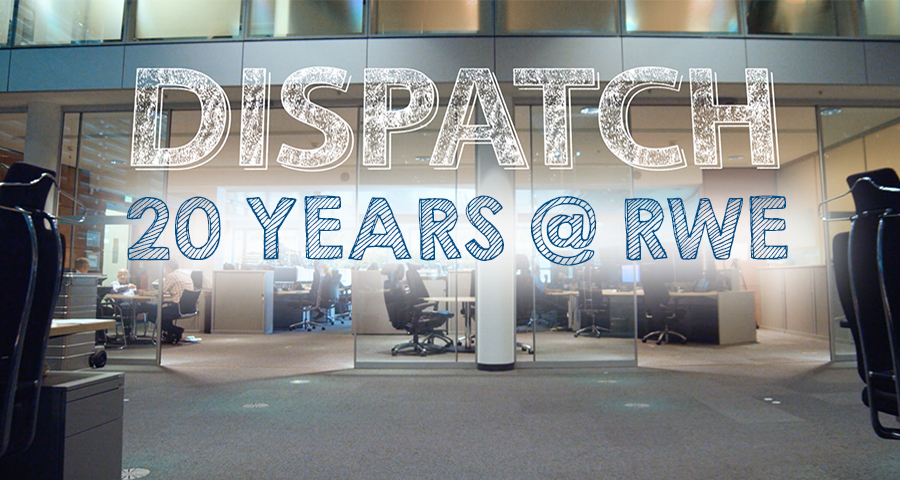
RWE Supply & Trading (RWEST) is celebrating the 20-year anniversary of Load Dispatch, now known as the Dispatch Centre. team: met with Guido Hommelsheim, Head of Dispatch at RWEST for a conversation. He was there from the very start and was able to give us a personal account of twenty action-packed years.
Guido, you were one of the “founding fathers” of RWE Load Dispatch. How did that all start for you?
Guido Hommelsheim
It all began for me in the System Control Centre of Brauweiler, now Amprion. Prior to 1998, that was where RWE Grid Management, all interconnections to Germany’s neighbouring countries and Power Plant Dispatch was centralised in one place. Following EU-wide electricity market liberalisation, an operational separation had to be made. After that, commercial power plant dispatch was to be managed in Essen. On 1 July 1998, the first night shift was worked on the 16th floor of Huyssenallee 2. We started out in Essen with a total of three employees, one manager and two temporary colleagues helping us out.
Were there any special challenges at the start of your career?

To begin with, while we were still in Brauweiler, I found it especially hard to gain the acceptance of my older colleagues. Not everyone was delighted to find a 24-year-old “lad” running the power plant. I had a few obstacles put in my way now and then, but you can only learn from such situations and grow as a result. When we started in Essen, it was different kind of challenge altogether. Suddenly we three young provincial lads (from Rhineland and Westphalia) not only had to get used to new modes of behaviour but also deck ourselves out in suits and ties, which I can look back and smile about now.
What were the early days in Essen like for you?
I can well remember that commuting by train caused a few problems with our shift work hours. After 9 pm there was only one express train per hour between Cologne and Essen. That was pretty difficult, but we overcome that problem too. It was also a big change for us, moving from the rather rugged environment of the System Control Centre to the central administration office in Essen. Our office was on the 16th floor in Huyssenallee and back then we could only dream of having a monitor wall like the one we have today. The two of us sat there, one shift engineer and one pre-planning engineer, in a small office and we had four screens at our disposal.
What has been your experience of the many changes during your career in the Dispatch Centre?
It has been a continually exciting experience for me. In 1999 we were able to set up a real structure with several colleagues, including better technical equipment and our first monitor wall. With the merger of RWE and VEW came the first trading floor to Essen in the same year and this led to our first direct contact with traders. Working together was a whole new world for both parties and we had to learn to get along with each other. Then in 2009 Plan-H was inaugurated and I was one of the first from what was then RWE Power AG to move to RWE Supply & Trading. Under the leadership of Martin Keiner, the Dispatch Centre was incorporated into CAO (Commercial Asset Optimisation) and restructured. All in all, you could say that the only constant over the past 20 years of Dispatch Centre has been change and still is to this day. No stone was ever left unturned.
When you cast your mind back to the past – what were the stand-out moments for you?
Definitely our first P&L (editor’s note: Profit and Loss) in fiscal year 2010. It was still pretty error-ridden at the time, but we learnt from it and were able to rectify all the problems. The operational merger with Essent in the Netherlands in 2013 was also a highlight for me. Together with our colleagues from Den Bosch, we added the RWE power plants in the Netherlands and Belgium to our existing Load Dispatch in Essen, with the result that all power plants in Germany, Belgium and the Netherlands have since been controlled and optimised centrally from Plan-H in Essen. Unfortunately the positive moments are not the only ones that stick in my mind. When we heard the sad news of the sudden death of one of our Dutch colleagues, it came as a huge shock to us all. The Dispatch team has remained very constant for many years, which is not all that common for staff on shift work. We have always had a huge sense of solidarity and that makes me particularly proud when I look back on the last 20 years.
What does the future hold for you?
The segment will and must continue to develop. Here too the same principle applies, that nothing is more constant than change itself. At the moment we are working on a new SCADA system, as a replacement for the two existing systems. For the whole CAO area, the merger with E.ON will be an exciting challenge, in terms of managing renewables.
To learn more about the work of our colleagues in the Dispatch team, watch this video and click on this Link (via RWE Intranet only).
Read more